Tuesday, 26 June 2012

What are the benefits of being a Consultant/Contractor

First job or seasoned veteran deciding to be a consultant/contractor is a big decision.  It is important that you know your own personality.  Consultants don't have the security that you do in a permanent/corporate position (most of the time).  You are basically running your own business.  So if you fret a lot about your next pay cheque than contracting may not be right for you.  But if you are confident and secure in yourself than there are alot of good reasons for contracting over permanent employment.

  • Most consultants are paid hourly wages/salaries that are higher than the permanent employees.  This is because you don't receive the benefits of full time employment, ie medical, dental, sick days, etc.  
  • You are running your own business so you can decide where your money goes, ie if you are single then maybe benefits aren't that important whereas if you have a family you may want to sign up for a benefits package through a health provider.  There are no union dues. 
  • There are good tax write offs, ie your car, your home office, entertainment, computers, printers, education, benefit packages, etc.  These can all become business expenses. 
  • You may get to work remotely if that appeals to you.
  • The chance of feeling in a rut is less likely in a contract position as you have the opportunity to work for a number of different companies on a number of different systems.  This will enhance your training and sale ability.  Big corporate companies tend to put you in a slot and then leave you there so your resume can look a little boring if you have been doing the same job, working on the same system for the last 5 years. 
  • There is the opportunity to travel.  It is much easier to work in another country on a short-term contract than it is to try and get a work visa.
  • If you want to take an extended holiday then just work your contracts around the dates you want to be away.
  • Company politics - not your business, you don't have to get involved.
  • If you find a job and a company that really interests you, and you are doing a good job then there is an opportunity to get in full time.
As the global economy has changed over the last thirty years, there is a need for both contract and permanent positions in nearly all companies.  If you decide to contract remember it's not cut in stone.  The important thing is to keep gaining experience and growing your network.

Let me know if in your experience you can think of any good reasons for chosing the consultant/contractor career path.

Wednesday, 20 June 2012

Do you take that new job or not

You made the big step and applied for the job, you've had the interview and now you have been offered the job.  Wow, now you are a little nervous.  Do you really want to switch jobs?  Is your old job so bad?  If this is a contract position it's not such a big deal, you know you are going to be there for a short period of time, but if this is a permanent move to a permanent move you need to make sure you make the right decision. 

My best advice for everything is make a list. 

Make a list of why you want to leave your old job or what you would like to find in a new job.  There should be some overlapping of reasons, ie no advancement in your old position while the new one offers you some supervisory duties.
  • Want more money
  • No possiblility for advancement
  • Working on an old system and you want to upgrade your skills
  • Too long a commute
  • No chance for travel
  • Want a bigger company to get better benefits
  • Not enough vacation time
  • No ability to work remotely
  • Training programs
Now you analyze, what are the most important reasons.  If you hate commuting and your new position is an hour away in rush hour bumper to bumper traffic you might want to decide whether the new position offers enough incentives to cancel out the commute.  Being able to work from home 2 days a week would make the commute not seem so bad.

The important thing is that you make the decision, not your recruiter, not your partner, YOU.  Listen to their advice but remember you are the one who will be dealing with this new position every day.

And be prepared for a counter offer when you resign, then it's back to the list.  Look at the reasons again, and try not to let the counter offer go to your head. 

Good Luck


Thursday, 14 June 2012

Should you send your resume in a PDF or word format?


BOTH would be my answer.  You probably set up your resume in word and then created a PDF file from it.  So why not send both and here's my reasoning.

PDF files are used because it gives you an exact picture of the way you set it up. This way all your text boxes, graphs, and pictures will stay lined up the way they were formatted. The problem appears when you are dealing with a company that wants to "tweak" your resume before they send it to their clients. Recruiting companies like to enhance your resume with little things like highlighting key words or more major things like removing all the "I did" and changing them to action words like "designing, developing, etc". They know their client's specific needs and want to make sure these points are clear and concise in your resume.

PDF files can be very difficult to copy into word documents. I have seen files copy over and put one word on each line. This can then mean a total retype, which takes time and time can sometimes be the difference between having your resume processed or not.

Word documents are easy to revise and search on. Recruiters will take your resume and put it on their letterhead for presentation to their clients. Companies receive so many resumes that recruiting agencies have standardized their resumes so that when their client looks at one of their resumes they know exactly where everything is, ie Education at the top, followed by Technologies, followed by Professional Experience.  This allows HR to quickly glance at the resume and make sure that the key ingredients are there.

So be efficient and send both a word document and a pdf file (if you are worried about the layout).

Monday, 11 June 2012

How to answer "What skill could you most improve on"


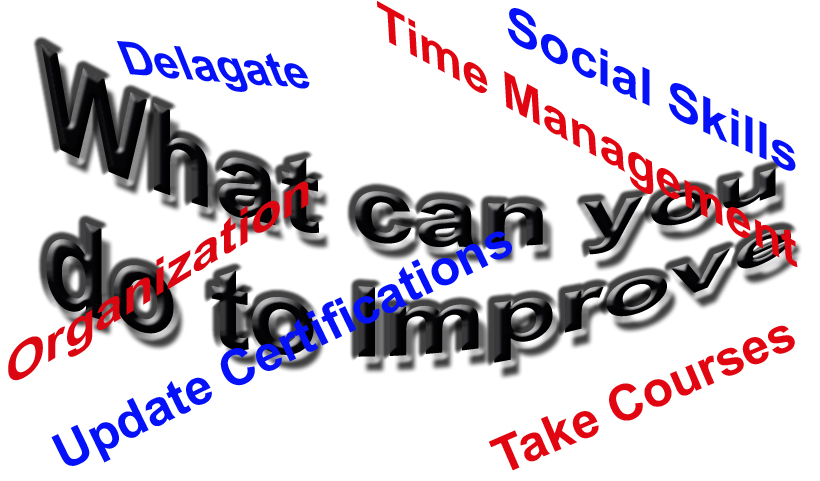
As an interviewer I like to promote the positive so instead of asking "what is your greatest Weakness". I would rather ask you about what you would like to improve about yourself. There are so many ways to answer this and make yourself sound professional, but also willing to improve. Everyone has something they can improve on. Time management, organization, procrastination, an actual skill, social skills, etc
  • So let's say you have an issue with time management you could answer by saying "I found I was getting behind on projects so i started using "timelines" and "to do lists" to keep me on track. Now I follow them diligently."
  • Improving a skill is always a good fall back answer, so try something like. "I have been neglecting renewing my certifications so have set myself up a "goal to do list" including renewing at least two certificates a year and looking into some new ones".
  • Social skills an issue. "Sometimes I feel when I am involved in a project I can become abrupt so i have been working on listening better to my peers questions and answering in a calmer tone."
  • Learning to delegate. "it has taken me awhile but I know I have to work on my delegation skills. In my previous position I was trying to do everything myself and i was always rushing around at the end of the job trying to finish up. Now I use my teams skills better and delegate where possible."
Be honest about yourself. Think about where you could use some improvement, everyone can improve something, and if you can relate it to the job description even better.

Good Luck

Friday, 1 June 2012

How to Answer "What STRENGTH would you bring to this position?"

The best way to be prepared for this question is to sit down and write down your strengths from a previous position or if you are a new graduate then experiences from school.  Below are a few examples of strengths that can be expanded upon with your experience as they fit the job description:
  • Team Player
  • Time Management
  • Good at managing people
  • Meeting deadlines
  • Always finish my tasks
  • Good listener
  • Deal well with difficult customers/situations
  • Able to see the big picture
  • Good with detail
  • Pick out a skill from the job description, ie “With my strong web design, creative writing, phone skills, etc” , then expand on this strength.
  • Problem Solver
  • Able to juggle more than one task at a time

This is where it is very important to know the job description.  Hopefully, you have also had the chance to ask specific questions about the position before this question comes up.  Now you take your strength and the information you know about the position and put the two of them together.
  • I am very good at listening and putting people at ease, this allows me to deal effectively with difficult situations.  In my previous position there was a customer/employee ……..
  • Although I am a detail person I am also able to see the big picture, in my previous position (or while at school) I was assigned the task of ………
  • My creativity has been tremendously helpful in designing web pages over the last 5 years.  One particular webpage was just not …. and I  ……

If you are having a hard time coming up with a strength, then ask your family, friends and co-workers.  You will be surprised at what they come up with.  Just don’t get too bloated from all the accolades.  It is important to be a little humble with this question.  You don’t want to come across as having an “I’m GREAT, I’m a STAR” attitude.

Don’t stress about this question, you have applied for the job because you know you can do it.  Now tell them why and how.  Be a "star".

Good luck

Thursday, 24 May 2012

How to answer "Why are you leaving your current job?"


Companies are always interested in why you are looking for a new job.  Depending on the answer they can get a good feel for you as a person and whether they want you working for their company. 
  • Do you like to change jobs?  bad attitude
  • Are you looking for advancement?  good attitude
  • Are you trying to increase your knowledge? good attitude
  • Did you have an issue with your boss/co-workers?  bad attitude
Positive, positive, positive - yes always try and keep your answers positive.  Below are some guidelines that you can expand on by bringing the job opening and your skill set/goals into the answer.   
  • I had reached the top of my level in my previous position and am looking to expand my knowledge.  This position and your company will offer me the opportunity to do that. 
  • The last company I worked for was very small and I felt it was time to move into a large corporate office to increase my challenges. 
  • My last position was a wonderful place to work for right out of school, and now I would like to move my career into a new path.
  • My family life has changed and I am looking to work closer to home.  Your company is closer to my home and still offers me the challenges and opportunities I need in my position.  I am very excited about being able to utilize some new skills and polish up some old ones. 
  • A friend sent me your job posting and the position sounded right up my alley.  After researching your company I feel like I would be an ideal match for this position. 
  • It is very important for me to be challenged in my position and it was time for a change.  Your company is using a system I am looking to increase my knowledge of. 
  • My last company went through a down turn and I realized that my position was being downsized.  This has given me the opportunity to look for new challenges and after researching a lot of companies, I feel that my entrepreneurial nature will fit in very nicely with your company.....
Never be negative.  The last thing you want to do is sound whinny
  • I couldn't work for my boss anymore
  • My co-workers were impossible to get along with
  • They were always advancing their children
So remember:
  • Be positive
  • Answer the question
  • Follow it up with promoting your skill set
  • And finally why the new company is so much better suited to you
Good luck

Thursday, 17 May 2012

The Interview Thank You Email

You've just walked out of your first, second or third interview. This is a good time to grab a coffee and take 15 minutes to make some notes from the interview.
  • What the people were like? Write a couple of points on the back of their business cards (which you remembered to ask for).
  • How you did?
  • Any questions you forgot to ask?
  • Why you still want the job?
  • Why you are the right person for the job?

Later that same day sit down and compose your email.  Remember if you were interviewed by a panel then you want to send a personalized email to each person.  Your "thank you" should be sent out within 48 hours.  Why??
  • You want them to read the email and remember you. 
  • And no point sending out a email after they have made the decision.

Your email should be formal, starting with
  • "Dear Person's Name" and ending with
  • "Sincerely Your Name, Contact Info".


The body of your email should be 3 or 4 paragraphs (4 maximum). 
  • First paragraph will be a general thank you for meeting you and what a pleasure it was to learn more about your company, etc
  • Second paragraph will reiterate your skills and why you now feel like this is the job for you.
  • Third paragraph a looking forward to hearing from you at my number/email below.

A few final things:
  • Keep it short and sweet/positive
  • Proofread, proofread, proofread

For some sample thank you letters, check out about.com at the link below.

Sample Thank You Email


Last thing to do - cross your fingers and wait for your job offer.  Good Luck